
CONSUMER GUIDE TO REDUCING VEHICLE IDLING
from the U.S. Department of Energy's Office of Energy Efficiency & Renewable Energy
THE FULL INFORMATION IN THIS DOCUMENT CAN BE ACCESSED BY CLICKING ON IT OR BY READING ITS TEXT BELOW.
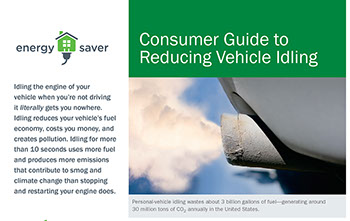
It is estimated that idling personal vehicles generate around 30 million tons of carbon dioxide (CO2) every year. While the impact of idling may seem small on a per-car basis, the impact of the 250 million personal vehicles in the United States idling adds up. For saving fuel and reducing emissions, eliminating the unnecessary idling of personal vehicles would be the same as taking 5 million vehicles off the roads.
Modern Cars Do Not Need to Idle
Advances in vehicle technology have made it easier than ever to avoid idling. Current vehicle owner’s manuals, which contain information on how to get the best and most economical performance, often recommend avoiding idling.
In today’s vehicles, driving helps the engine reach its ideal operating temperature faster than idling it. The catalytic converter, which reduces emissions, operates much sooner if the car is driven. Even on the coldest days, most manufacturers recommend avoiding idling and driving off gently after running the vehicle for about 30 seconds. Not only will the engine warm up faster by being “at work,” but the car’s interior will warm up more quickly as well. Similarly, today’s gasoline and diesel vehicles do not suffer damage by being turned on and off. Starters and batteries are much more durable now than they were in the past.
Consider Your Circumstances
Drive-through lines are a common place for vehicles to idle. If a line at a drive-through restaurant, pharmacy, or bank is long, consider turning off your car while you wait or parking and going inside. Likewise, when waiting for passengers, consider the weather. If the temperature is moderate, turning off your engine makes sense.
It is especially important for caregivers waiting to pick up schoolchildren to minimize idling because vehicle emissions are more concentrated near the ground, where children breathe. Poor air quality can contribute to asthma and other ailments. Plus, children’s lungs are more susceptible to damage than adults’ lungs are, because their respiratory systems are still developing and they have faster breathing rates. Not only can auto exhaust from idling pollute the air in and around vehicles; it can also enter school buildings through air intakes, doors, and open windows. Auto-exhaust pollutants contribute to ozone pollution, acid rain, and climate change. To protect public health, many community anti-idling campaigns have targeted school zones, and school districts nationwide have enacted policies to limit idling by school buses and personal vehicles waiting to pick up children. There are several sources of information on designing a campaign that works for schools, many of which teachers can use as environmental education teaching tools.
Solutions to Minimize Idling
For everyday drivers, the best way to reduce idling is to simply turn the key when stopped for 10 seconds or more, except in traffic. Driving a hybrid-electric vehicle makes idle reduction even easier. Hybrids shut off the engine when they are not moving and even enable slow movement with the engine off. “Mild hybrid,” or stop-start technology, which is increasingly available in a number of vehicles, also eliminates idling when the car is stopped.
A Few Exceptions
There are a few circumstances where idling is hard to avoid. When waiting in traffic, you must keep your car running for safety reasons. In winter, you may need to idle to defrost your windows. When bringing your car for vehicle emissions testing, your inspection station may require that you idle to keep your engine at operating temperature. Idle at a minimum to decrease your emissions impact.
________________________________________
THE U.S. EPA’S SMOG VEHICLE EMISSIONS WEBPAGE STATES:
“Emission standards have made our air cleaner . . .
Smog pollution emission standards have been strengthened over time making our air substantially cleaner and healthier. NOx* emission standards for light duty vehicles in 2025 are a 98% improvement from 1975, and a major driver to the improvements in U.S. air quality.”
*Nitrogen oxides
“But NOx pollution is still a problem . . .
• These standards apply only to new cars, so many cars on the road emit more air pollutants than Tier 3 levels.
• These are standards, not total (actual) pollution levels. As we continue to drive an increasing amount, strong smog standards can help keep total NOx pollution on a downward trend.
• In 2018, approximately 125 million people lived in areas where, on average, air pollution was above healthy levels. Southern California’s smog levels were above federal standards for almost three months in a row that year. This is the region’s longest stretch of non-compliant days in at least 20 years. But unhealthy air is not unique to southern California—nearly half of states had at least one county with unhealthy air in 2018.”
________________________________________
COMMENT FROM GREEN DRIVING AMERICA: Light-duty gas vehicle idling emits more pollution than when traveling: When idling, the engine is running very inefficiently. Besides burning fuel while going nowhere (every 6–10 minutes of idling burns about the same amount of fuel as driving one mile), emissions per minute of NOx and other pollutants, such as benzene, carbon dioxide, carbon monoxide, hydrocarbons, and volatile organic compounds are much higher when idling than when traveling. And catalytic converters may cool down during longer idling periods, which reduces their pollution-control effectiveness. When traveling, especially at steady speeds, the engine operates closer to its optimal efficiency.