
The U.S. EPA’s Smog Vehicle Emissions webpage states:
“Emission standards have made our air cleaner . . .
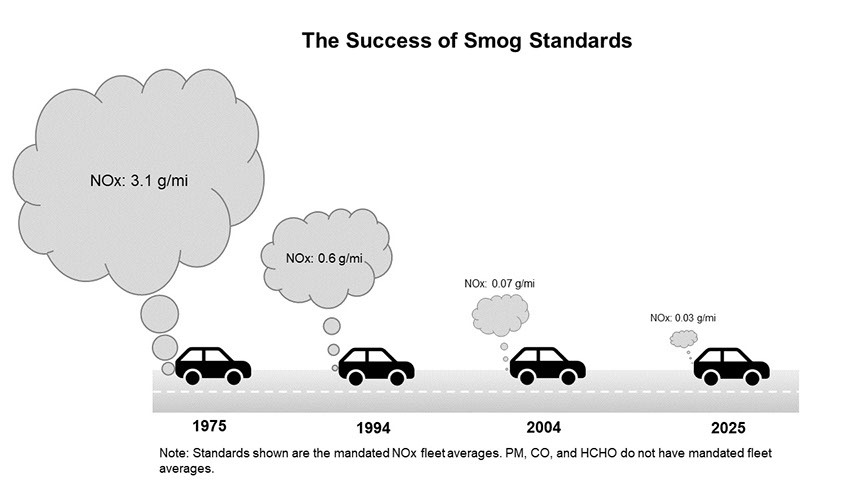
Smog pollution emission standards have been strengthened over time making our air substantially cleaner and healthier. NOx emission standards for light duty vehicles in 2025 are a 98% improvement from 1975, and a major driver to the improvements in U.S. air quality.”
NOx: nitrogen oxides
U.S. EPA - 2025
COMMENTS FROM GREEN DRIVING AMERICA:
BUT, if multiple light-duty vehicles are idling continuously, such as in drive-thrus and at schools, for schools, we can use a formula of a likely caravan of 50 waiting vehicles, including 30 gas vehicles idling, during a 15- to 30-minute school dismissal period:
NOx 0.03 grams/mile from one 2025 vehicle x 30 = 0.9 grams/mile - more than the equivalent of one 1994 vehicle idling with inferior emissions standards; older vehicles in such a caravan, depending on their model years, could result in the doubling or even tripling of these NOx emissions.
ALSO, light-duty gas vehicle idling emits more pollution than when traveling: When idling, the engine is running very inefficiently. Besides burning fuel while going nowhere (every 6–10 minutes of idling burns about the same amount of fuel as driving one mile), emissions per minute of NOx and other pollutants, such as carbon dioxide, carbon monoxide, and volatile organic compounds are much higher when idling than when traveling. And catalytic converters may cool down during longer idling periods, which reduces their pollution-control effectiveness. When traveling, especially at steady speeds, the engine operates closer to its optimal efficiency.
And, further, the U.S. EPA states:
“But NOx pollution is still a problem . . .
• These standards apply only to new cars, so many cars on the road emit more air pollutants than Tier 3 levels.
• These are standards, not total (actual) pollution levels. As we continue to drive an increasing amount, strong smog standards can help keep total NOx pollution on a downward trend.
• In 2018, approximately 125 million people lived in areas where, on average, air pollution was above healthy levels. Southern California’s smog levels were above federal standards for almost three months in a row that year. This is the region’s longest stretch of non-compliant days in at least 20 years. But unhealthy air is not unique to southern California—nearly half of states had at least one county with unhealthy air in 2018.”